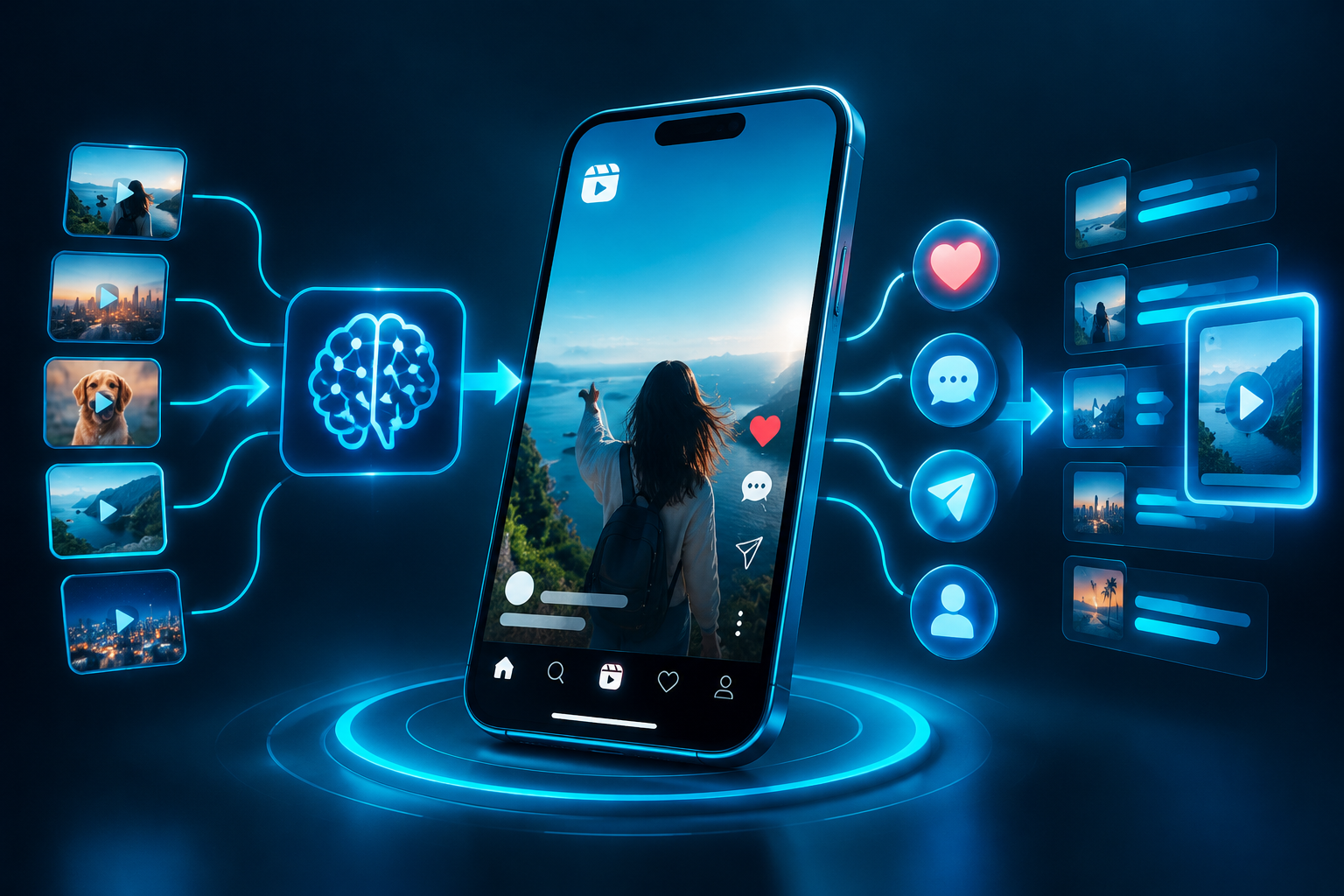
Instagram Reels distribution is driven by observed viewer behaviour rather than a fixed publishing schedule. Understanding the signals helps teams prioritize production decisions instead of guessing.
The signals that matter
- Watch time and completion rate — the strongest signal that the content delivered on its promise.
- Rewatches — indicate that the content is short enough and interesting enough to repeat.
- Saves and shares — indicate practical value or strong emotional resonance.
- Profile visits and follows — indicate that the account promise is clear.
- Comments — useful for topic validation, but not the only quality signal.
The three-second hook
The opening three seconds determine whether the rest of the video is watched. A strong hook usually does one of four things:
- States a specific outcome the viewer wants.
- Shows a visual result before explaining the process.
- Challenges a common assumption.
- Creates an open loop that is resolved later in the video.
If the hook can be removed without losing meaning, it is not a hook.
Structure for completion rate
- Keep one idea per video. Two ideas split attention and reduce completion.
- Cut dead frames and pauses; Reels reward density.
- Use on-screen text to reinforce the spoken message, not to repeat it word for word.
- Place the call to action after the value has been delivered, not before.
- End with a reason to rewatch or save.
Test one variable at a time
Teams often change the hook, length, music and caption at the same time, then cannot explain the result. Test one variable per cycle:
- Week 1: two hook styles, same topic and length.
- Week 2: two lengths, same hook style.
- Week 3: two caption styles, same video edit.
Conclusion
Reels performance is less about posting more and more about improving the first three seconds, completion rate and save-worthy value. Build a small testing system and let the data decide the format.
Need support with Reels operations? Talk to our team.